Islamic Calendar 2027 January
Welcome All! The Islamic Calendar 2027 January (HIJRI Calendar) Free pdf can be downloaded here.
Islamic Calendar 2027 January: January 2027 Islamic Calendar with every festival, blessed night and Roza (روزہ) in one place? Here we give the full calendar for the month, along with the complete list of Islamic festivals, important dates and holidays. The PDF of this month’s calendar is given below on this page.
This جنوری اسلامی کیلنڈر 2027 covers the closing part of Rajab 1448 Hijri (رجب 1448 ہجری) and the opening part of Shaban 1448 Hijri (شعبان 1448 ہجری). The month holds two of the most awaited nights of the year, Shab-e-Meraj (شبِ معراج) and Shab-e-Barat (شبِ برات), along with the Ayyam al-Beed fasts and the weekly Jumma (جمعہ). The date of each one is in the table below.
Islamic Calendar 2027 January
Here is the (Hijri) islamic Calendar for January 2027 for you to read.
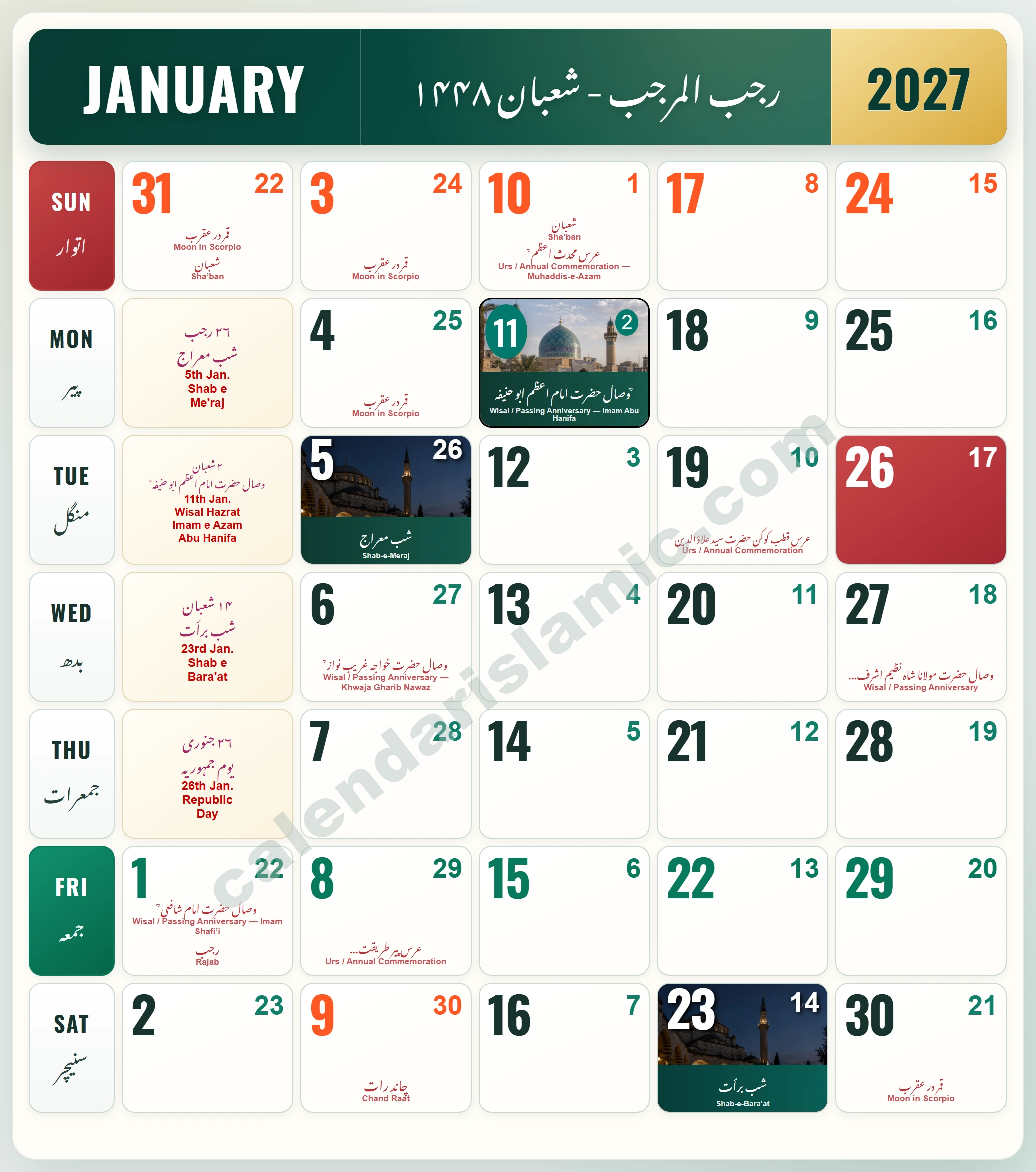
Islamic Calendar 2027 January Calendar Festivals And Important Date
| Date | Day | Islamic Date (Hijri) | Festival / Occasion |
|---|---|---|---|
| 5 January | Tuesday | Night of 27 Rajab 1448 | Shab-e-Meraj (night) |
| 6 January | Wednesday | 27 Rajab 1448 | Day of Isra and Meraj, nafl roza kept by some |
| 10 January | Sunday | 1 Shaban 1448 | Start of Shaban |
| 22-24 January | Friday to Sunday | 13-15 Shaban 1448 | Ayyam al-Beed fasts |
| 23 January | Saturday | Night of 15 Shaban 1448 | Shab-e-Barat (night) |
Islamic dates depend on the sighting of the Chand (چاند), so every date here is expected and can shift by a day in your area. The Islamic day begins at sunset, so a night of worship starts on the evening shown. If the Rajab moon was sighted a day earlier where you live, Shab-e-Meraj would fall on the evening of 4 January and Shab-e-Barat on the evening of 22 January.
Hijri Months and Jumma Dates in January 2027
When January opens, Rajab 1448 Hijri is already in its fourth week, since the month is expected to have started in India on 11 December 2026. Rajab is expected to complete thirty days, and Shaban 1448 Hijri is expected to begin on Sunday, 10 January, after the new moon is looked for on the evening before. Shaban then runs through the rest of the month, and the Hijri year stays 1448 throughout.
The Jumma dates in January 2027 are 1, 8, 15, 22 and 29 January, five Fridays in all. In many homes Friday starts with ghusl and clean clothes, and men try to reach the mosque early for the Jumma Namaz (نماز) rather than rushing in during the khutbah.
Major January 2027 Islamic Festivals and Occasions Explained
Rajab 1448 Hijri – Closing Days
The year opens in the last stretch of Rajab 1448 Hijri, one of the four sacred months in Islamic tradition. Many Muslims treat it as a quiet lead-up to Shaban and Ramzan (رمضان), with more nafl fasts, more Quran recitation and some extra charity.
Rajab is expected to end on Saturday, 9 January, after which the Chand is looked for to begin Shaban. Practices for the month differ from one community to another.
Shab-e-Meraj – 5 January
Shab-e-Meraj is the night of 27 Rajab 1448 Hijri, and it begins after sunset on Tuesday, 5 January. According to Islamic tradition, on this night the Prophet Muhammad (peace be upon him) was taken from Makkah to Masjid al-Aqsa and then raised through the heavens, an event known as Isra and Meraj.
It is narrated that the five daily prayers were given to the Muslim ummah on this occasion, which is why many people give extra attention to their namaz on this night. Scholars have long held different views on the exact date of the event, so some communities mark the night with special worship while others treat it like any other night of Rajab.
The day that follows, Wednesday 6 January, is 27 Rajab itself. Some people keep a nafl roza on it, while others do not; ask a local imam if you want guidance for your own practice.
Start of Shaban – 10 January
Shaban 1448 Hijri is expected to begin on Sunday, 10 January. It is the month just before Ramzan, and according to Islamic tradition the Prophet (peace be upon him) used to fast often during it.
In many homes, Shaban is when Ramzan preparations quietly begin. People start clearing pending qaza fasts, plan their zakat, stock up on dates and basic groceries, and try to settle into a regular habit of Quran recitation before the holy month arrives.
Ayyam al-Beed Fasts – 22 to 24 January
The Ayyam al-Beed, or “white days,” are the 13th, 14th and 15th of each Hijri month, when the moon is at its fullest. In Shaban 1448 Hijri they are expected to fall from Friday, 22 January to Sunday, 24 January.
These are nafl fasts, and keeping them is entirely voluntary. The third day is 15 Shaban, the day after Shab-e-Barat begins, so those fasting can complete the set of three.
Shab-e-Barat – 23 January
Shab-e-Barat is the night of 15 Shaban 1448 Hijri, and it begins after sunset on Saturday, 23 January. Many Muslims believe it is a night of forgiveness and mercy, when the coming year’s matters are decided, and they spend part of it in prayer and dua.
In India the night has a strong household character. Halwa of chana dal or suji is cooked in many homes, the graves of elders are visited, and mosques stay busy late into the night. Practice differs here too: some communities observe the night with special gatherings, while others keep it simple or do not mark it separately.
Roza Rules, Food and Precautions for January 2027
There are no obligatory fasts in January, as Ramzan is still ahead. The fasts of this month are all nafl: the regular Monday and Thursday fasts, and the Ayyam al-Beed in Shaban. None of them is required, and there is no day this month on which fasting is not kept. Winter days are short, so the fasts are among the easiest of the year to manage.
Commonly chosen Sehri and Iftar foods:
- Dates and a glass of water to open the fast
- Warm milk, tea or a light soup at iftar on cold evenings
- Roti or paratha with eggs, dal or curd at sehri
- Seasonal fruit such as oranges, guava and apples
- Light home-cooked food rather than heavy restaurant meals
- Only halal food and drink at every meal
Things avoided during a roza:
- Eating, drinking and smoking from dawn until sunset
- Quarrels, lying and backbiting, which according to Islamic teaching take away from the fast
- Overeating fried snacks and very salty food at iftar
Practical precautions:
- Eat warm food and dress well for early sehri, as winter mornings can be cold and foggy
- Keep drinking water between iftar and sehri, since people drink less in the cold without noticing
- Those on regular medicines, and anyone with diabetes, blood pressure or another health condition, should speak to their doctor before fasting
- Children, pregnant or nursing women, older adults, travellers and the unwell are given concessions in Islam, so ask a local scholar about your own case
- Keep food fresh and clean, and avoid leftovers that have been sitting out
- Check your local mosque timetable for Sehri and Iftar timings
How the Major January 2027 Occasions Are Observed
Shab-e-Meraj
For those who observe it, this night is a reminder of the gift of namaz and a chance to renew one’s prayer habit. Before the evening, people usually clean the house, bathe and set aside clean clothes and a prayer mat.
- Perform wuzu or ghusl after Maghrib.
- Offer the Isha namaz, at the mosque or at home.
- Spend some time in nafl prayer and reciting the Quran.
- Listen to a talk at the local mosque about the events of Isra and Meraj, where one is held.
- Make dua in one’s own words for oneself, the ummah and the departed.
Customs vary between communities, so a local imam is the right person to ask about specific prayers for the night.
Shab-e-Barat
Many Muslims see this night as a time to seek forgiveness and to remember those who have passed away. During the day, homes are cleaned, halwa is prepared, and food is set aside for neighbours and the needy.
- Perform ghusl in the evening and wear clean clothes.
- Offer Maghrib and Isha at the mosque, then spend part of the night in prayer and Quran recitation.
- Visit the graves of elders and make dua for them.
- Give charity and share halwa or other food with neighbours and the poor.
- Keep a nafl roza the next day, if one is able to; it is also the third of the Ayyam al-Beed fasts.
Some communities do not hold special worship on this night, and that view is held respectfully alongside the others. For safety, people are also asked to avoid firecrackers and late-night bike rides.
Ayyam al-Beed Fasts
Fasting on the three white days is a long-standing nafl practice that many Muslims try to keep every month. In January, people usually plan a simple sehri the night before and keep dates ready for iftar.
- Make the intention for the fast before dawn.
- Have sehri, even if it is only a few dates and some water.
- Keep the fast from dawn to sunset, guarding the tongue as well as the stomach.
- Open the fast at Maghrib with dates and water and make dua.
- Offer the Maghrib namaz before sitting down to a fuller meal.
Frequently Asked Questions
Which Hijri months fall in January 2027?
January 2027 covers the end of Rajab 1448 Hijri and the start of Shaban 1448 Hijri, with Shaban expected to begin on Sunday, 10 January in India.
Why can Islamic dates differ by a day from place to place?
Each Hijri month begins when the new moon is sighted, and sighting differs by region. All dates here are expected and depend on the moon in your area.
Which are the main Islamic festivals and fasts in January 2027?
The جنوری اسلامی کیلنڈر 2027 includes Shab-e-Meraj on the evening of 5 January, Shab-e-Barat on the evening of 23 January, and the Ayyam al-Beed fasts from 22 to 24 January.
Are Namaz, Sehri and Iftar timings the same in every city?
No. These timings change with the position of the sun in each place, so check your local mosque timetable for the correct times in your city.
How should I use the January 2027 Islamic calendar PDF?
Print it or keep it on your phone to track Hijri dates, Jumma days and nafl fasts, and confirm each date with your local mosque after the moon is sighted.
Conclusion
On this Article, I have given the (Hijri Calendar) Islamic calendar of January 2027 Month and I have also told when are the festivals and Fasts in January in the complete table format and when are the fasts in this Article post, if you liked this Article then definitely share it with your friends and family and you can read other Month Calendarz on our site , thank you visit our Article.